

Does “No” Lose Its Meaning After Marriage?
The debate around marital rape — non-consensual physical relations within marriage — continues to intensify in India. Even today, a large section of society believes that after marriage, a wife’s consent becomes permanent. However, women’s rights activists and mental health experts argue that such thinking goes against dignity, bodily autonomy, and basic human rights.
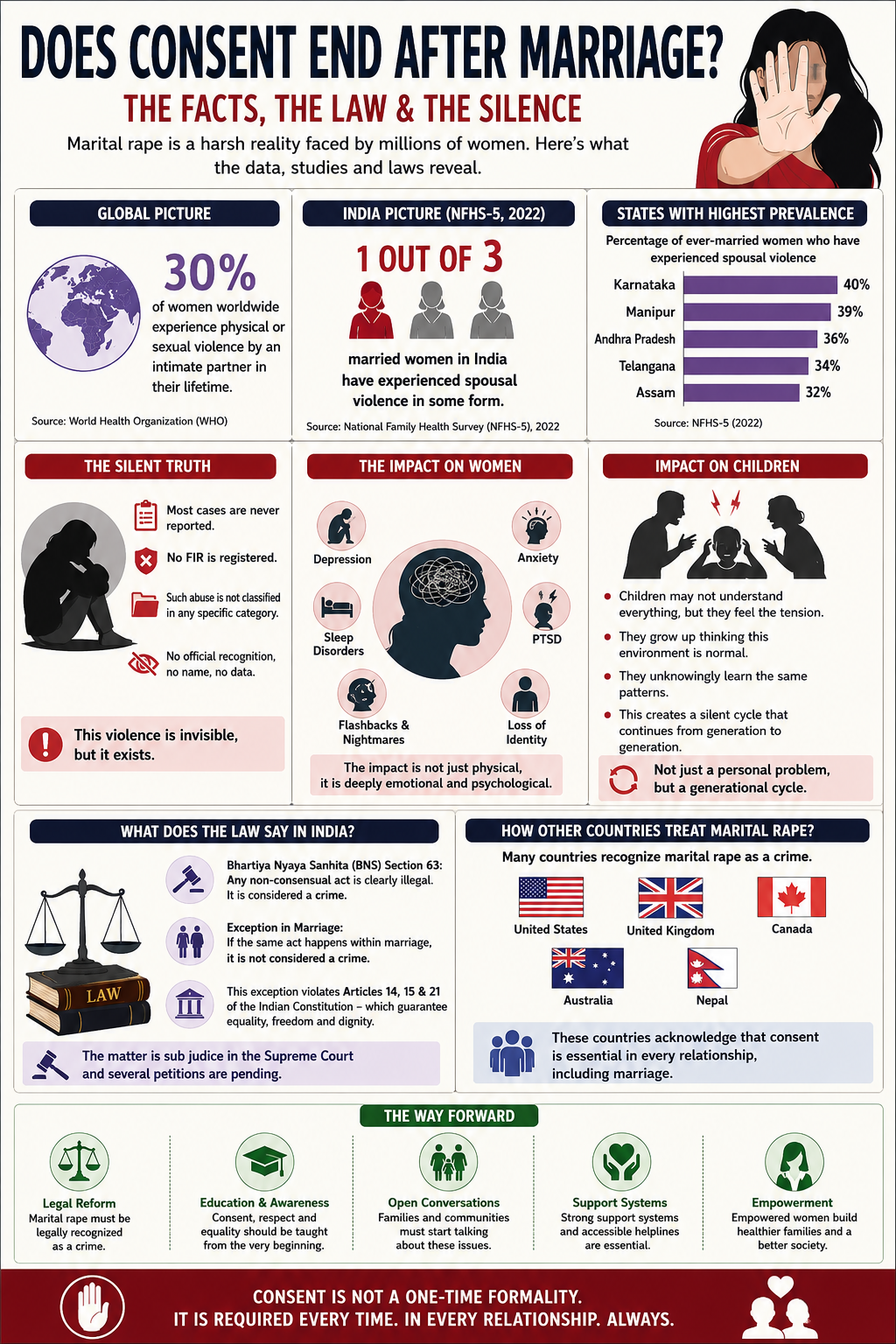
According to reports by WHO and NFHS-5, a significant number of married women face physical or mental abuse from their own partners, yet most cases are never officially reported. Social pressure, fear of family breakdown, shame, and the mentality of “adjustment” are considered major reasons behind this silence.
Under current Indian law, non-consensual relations within marriage are still not clearly recognized as rape. This legal exception has been under intense debate in the Supreme Court for years. Several petitions have argued that such provisions violate Articles 14, 15, and 21 of the Indian Constitution, which guarantee equality, freedom, and the right to live with dignity.
Experts believe that this issue is not only legal but also deeply connected to social conditioning. Women are often taught from childhood to “compromise” and “adjust,” causing many to normalize abuse within relationships. Mental health professionals associate this with psychological conditions such as learned helplessness and gaslighting.
Several countries including the United States, the United Kingdom, Canada, Australia, and Nepal have already criminalized non-consensual relations within marriage. In contrast, India still remains at the center of an ongoing legal and social debate on the issue.
Experts suggest that the solution lies not only in stronger laws but also in awareness, education, family discussions, and accessible support systems for women. Consent, they argue, must be understood as the foundation of every relationship.



Comments (0)