
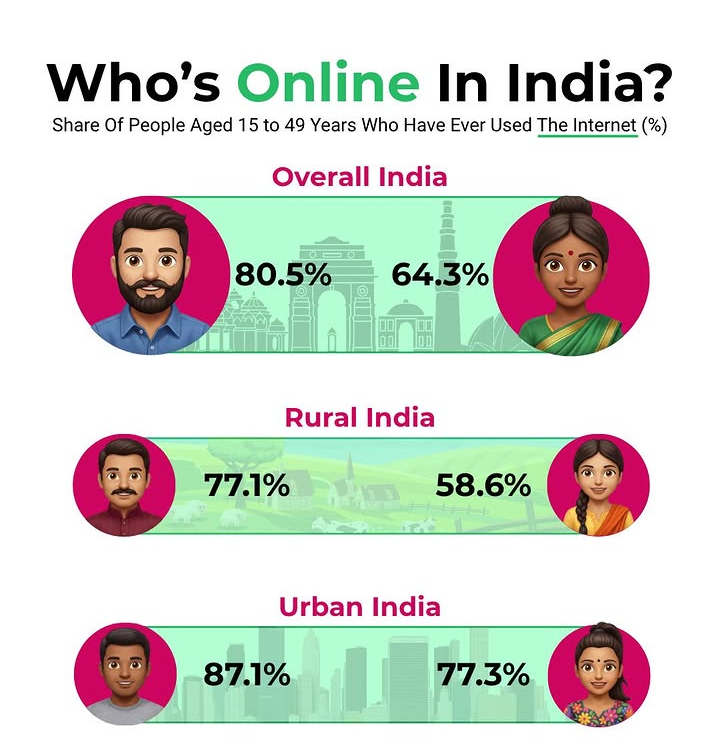
India continues to face a significant challenge in achieving gender equality in internet usage. The country records a 16.2 percentage-point gap between men and women in internet access. While 80.5% of men use the internet, only 64.3% of women have access to it.
The gap is most pronounced in rural India, where the difference in internet usage between men and women stands at 18.5 percentage points. This clearly indicates that women's digital access in rural areas remains limited and that greater efforts are needed to connect them with technology.
However, the data also highlights a positive trend. Internet usage among urban women stands at 77.3%, which is slightly higher than that of rural men at 77.1%. This suggests that better digital infrastructure, improved awareness, and easier access to technology in urban areas have contributed to increased internet access for women.
The gender gap can be reduced by improving education, digital literacy, access to smartphones, and the availability of reliable internet services. Digital inclusion initiatives undertaken by the government and the private sector are expected to further narrow this gap in the coming years.
In the digital age, the internet is not only a means of communication but also a vital gateway to education, employment, healthcare services, and government welfare schemes. Ensuring equal digital participation for women is therefore considered essential for achieving inclusive development.




Comments (0)