
India's First Private Orbital Rocket Vikram-1: Two Former ISRO Scientists Turned Their Dream into History — The Complete Story of Mission Aagaman
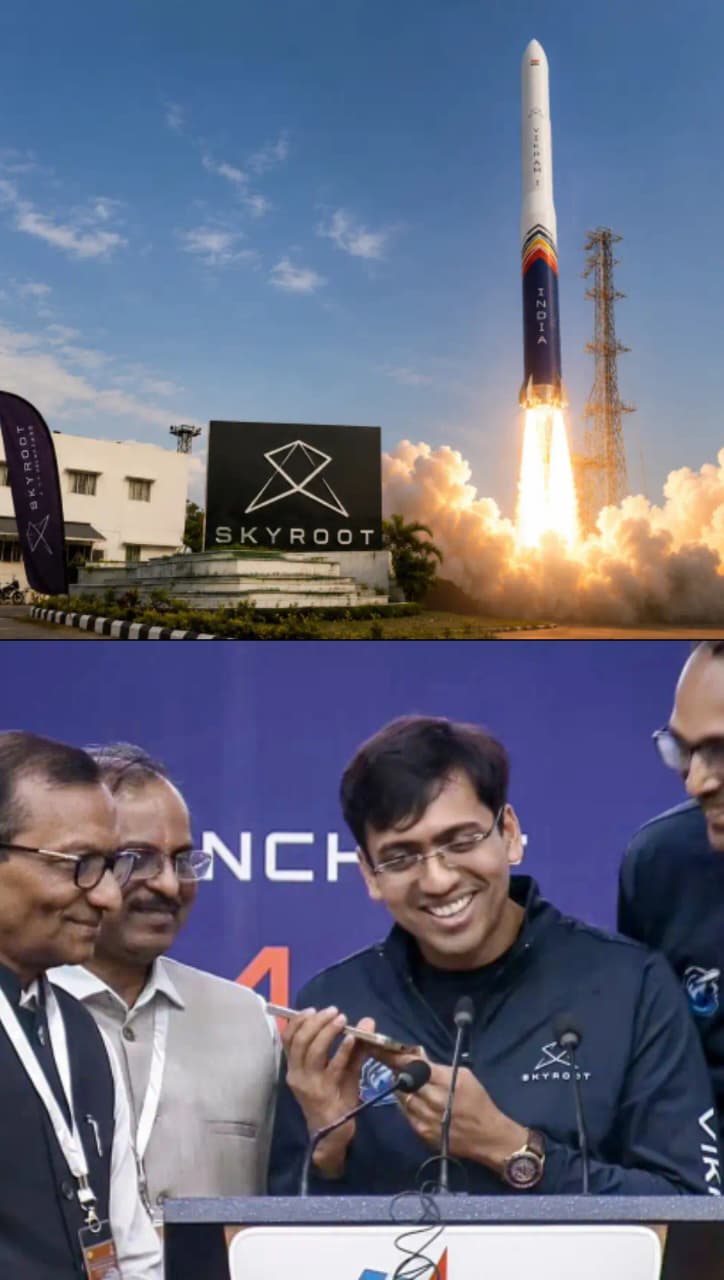
New Delhi/Sriharikota: July 18, 2026, became a landmark day in India's space history as the country demonstrated its strength in the private space sector, moving beyond government-led space missions. Hyderabad-based private space-tech company Skyroot Aerospace successfully launched its first orbital rocket, Vikram-1, completing India's first private orbital rocket mission. Conducted under the name Mission Aagaman, the launch placed India among a select group of nations where a private company has successfully developed and launched an orbital rocket. Around 15 minutes after lifting off from the Satish Dhawan Space Centre in Sriharikota, the rocket successfully placed its payloads into a Low Earth Orbit (LEO) of approximately 450 kilometers.
What Makes Vikram-1 So Special?
Private companies in India had previously launched sub-orbital rockets, but Vikram-1 is the country's first private orbital rocket to successfully place payloads into Earth's orbit. This achievement is regarded as one of the biggest milestones in India's private space industry.
A Dream Shared by Two Former ISRO Scientists
Skyroot Aerospace was founded on June 12, 2018, by former ISRO scientists Pawan Kumar Chandana and Naga Bharath Daka. They recognized the rapidly growing global demand for launching small satellites at lower costs and within shorter timelines. Driven by this vision, they started the company in Hyderabad with a small team of just ten people.
In its early years, the company faced several challenges, including limited resources, technological hurdles, and raising funds. Despite these obstacles, the team continued working on indigenous technologies, 3D printing, and advanced rocket propulsion systems. Within a few years, Skyroot became India's first space-tech unicorn.
Named After Dr. Vikram Sarabhai
Skyroot named its rocket series Vikram in honor of Dr. Vikram Sarabhai, the father of India's space program. According to the company, the name symbolizes India's scientific legacy and its future ambitions in space exploration.
From Vikram-S to Vikram-1
Skyroot's success did not come overnight. In November 2022, the company launched Vikram-S, a sub-orbital rocket, under the mission Prarambh. The mission successfully tested the rocket's engine, navigation, and flight control systems. The experience and data collected during that mission laid the foundation for developing Vikram-1, a full-fledged orbital launch vehicle capable of placing satellites into orbit.
Mission Aagaman: What Happened on Launch Day?
The countdown began at Sriharikota on July 18, 2026. During the final phase, the automated safety system detected a minor technical indication, resulting in a delay of about 35 minutes. Engineers thoroughly inspected all systems, and after confirming that everything was functioning normally, the launch was cleared.
Vikram-1 then lifted off successfully. The rocket completed all its flight stages as planned and, within nearly 15 minutes, deployed multiple customer payloads and technology demonstration experiments into a 450-kilometer Low Earth Orbit. The mission successfully achieved all its primary objectives.
Technical Highlights of Vikram-1
- Approximately 22 meters in height
- Payload capacity of around 350 kilograms
- Designed for commercial launches of small satellites
- Equipped with advanced propulsion technology and 3D-printed engine components
- Built for cost-effective and rapid launch services
- India's privately developed orbital launch vehicle for future commercial missions
What Did Mission Aagaman Carry?
Mission Aagaman carried multiple customer payloads and technology demonstration experiments into space. These payloads were aimed at testing new space technologies and showcasing commercial space services. With the successful deployment of all payloads, the mission accomplished all of its key objectives.
An Average Team Age of Just 28 Years
After the successful launch, Skyroot co-founder Pawan Kumar Chandana revealed that the team working on the Vikram-1 mission had an average age of only 28 years. The achievement has been widely recognized as an inspiration for India's startup ecosystem. He also noted that the success was the result of years of dedication, hundreds of tests, and thousands of hours of engineering work.
What Did Prime Minister Narendra Modi Say?
Following the successful launch, Prime Minister Narendra Modi congratulated the Skyroot Aerospace team and described the achievement as a "historic moment" in India's space journey. He praised the young scientists and engineers, saying they had proved that Indian youth can develop world-class technology when given the opportunity.
During his interaction with the team, the Prime Minister recalled that when the government opened the space sector to private participation in 2020, many had questioned the decision. He said the success of Vikram-1 had validated that faith in India's youth and startups. He added that the mission would inspire future generations to dream big and pursue innovation fearlessly.
Why Is This Mission Important for India?
In 2020, the Government of India opened the space sector to private participation. Through institutions such as IN-SPACe, private companies gained access to launch facilities, testing infrastructure, and space-related resources. The success of Vikram-1 is widely regarded as one of the biggest outcomes of this policy.
Experts believe the mission has positioned India as a strong contender in the global small satellite launch market. The government aims to expand India's space economy to nearly $44 billion by 2033, and Vikram-1 is considered a major milestone toward achieving that vision.
Conclusion
Vikram-1 is more than just a rocket—it represents the beginning of India's private space era. What started as a small startup founded by two former ISRO scientists has now become a symbol of India's growing scientific and technological capabilities. Mission Aagaman has demonstrated that India is no longer defined only by government-led space missions; it is rapidly emerging as a global force in private space technology as well.



Comments (0)