
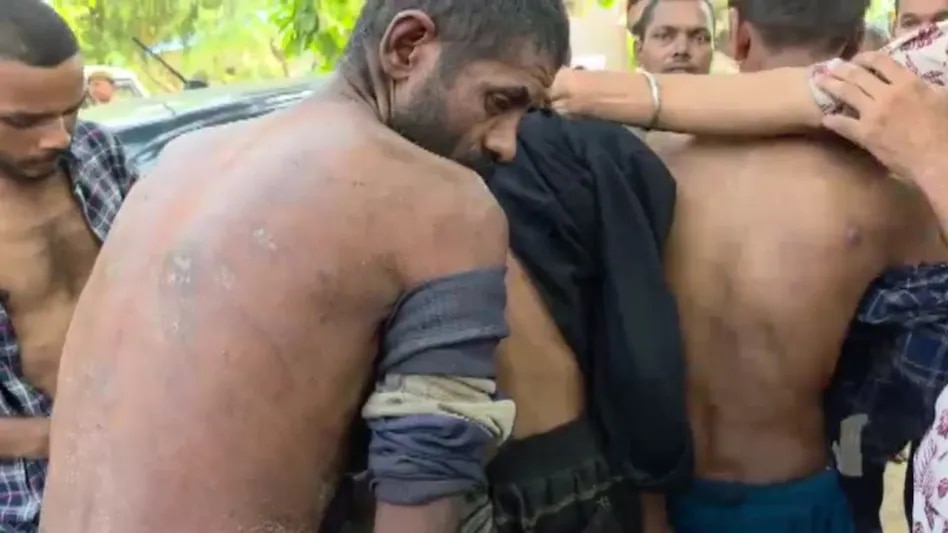
The alleged bonded labour case reported in Uttar Pradesh's Muzaffarnagar district has raised serious questions about the safety of workers and the implementation of labour laws. During a joint operation by the police and local administration, several workers were rescued from a factory manufacturing leaf plates and bowls. According to the preliminary investigation, the workers had been lured with false promises of employment and were later held captive inside the factory premises, where they were allegedly forced to work under inhuman conditions.
According to the initial investigation and statements given by the rescued workers, their mobile phones and identity documents were taken away from them. It is also alleged that they were not allowed to leave the factory for long periods and were physically assaulted if they protested. Police have arrested two accused in connection with the case, while the investigation is still underway.
Victims Recount Their Ordeal
Several of the rescued workers said they had been brought to Muzaffarnagar after being promised better jobs and higher wages. However, once they reached the factory, they claimed their freedom was taken away. They alleged that they were forced to work for long hours continuously and were beaten whenever they asked to return home.
Administration Begins Investigation
The police and the Labour Department have launched an investigation into the activities carried out at the factory. Officials said every aspect of the case is being examined, and if allegations of human trafficking, bonded labour, or violations of labour laws are confirmed, strict legal action will be taken against those responsible.
What Does the Law Say About Bonded Labour?
Under India's Bonded Labour System (Abolition) Act, 1976, forcing any person to work through coercion, debt, or deception is a criminal offence. In addition, Article 23 of the Constitution of India explicitly prohibits human trafficking, forced labour, and begar (unpaid compulsory labour).
Migrant Workers Face the Greatest Risk
Experts believe that migrant workers who travel to other states in search of employment often fall prey to fraudulent agents and contractors. Due to a lack of proper identification, legal awareness, and local support, they become the most vulnerable victims of such exploitation.
Several Questions Before the Administration
Following the incident, questions are also being raised about how workers could allegedly remain confined inside the factory for such a long period without the knowledge of the local monitoring system, the Labour Department, or other concerned authorities. The administration has stated that a fair and impartial investigation is underway and that action will also be taken against any official found negligent.
The Muzaffarnagar case is not merely a criminal incident but also a serious test of the country's worker protection system. The complete picture will emerge only after the investigation is concluded, but for now, the incident has reignited debate over bonded labour and the safety of migrant workers.


Comments (0)